Resume Keywords: List for 2026 + ATS Optimization Guide

Resume keywords are the specific terms, skills, and qualifications that Applicant Tracking Systems (ATS) scan for when evaluating your application. According to various online sources, 75% of resumes never reach human reviewers because they're filtered out by ATS. Therefore, if you're sending out applications without strategically placed keywords, you're essentially invisible to the companies you're trying to reach.
In this guide, we’ll show you how to identify and use the right keywords for a resume. Also, we’ll provide you with a short keywords list you can use, whether you're crafting your first resume or updating an existing one.
- Resume keywords are specific terms from job descriptions that ATS systems scan for when filtering applications.
- Keywords include hard skills, soft skills, certifications, industry terminology, and action verbs.
- Every resume should be tailored with keywords from the specific job posting you're applying to
- Keyword placement in key sections like your summary, experience, and skills matters for getting optimal results.
- Both exact matches and keyword variations help improve your ATS compatibility and ranking.
What Are Resume Keywords?
Resume keywords are specific words and phrases that appear in job descriptions and represent the skills and qualifications, and experience employers are seeking. When companies post a job opening, they describe their ideal candidate using particular terminology—and that's exactly the language you need to mirror in your resume.
ATS software scans incoming resumes for these keywords to determine whether candidates meet the basic job requirements before passing them along to human reviewers. When you pull keywords directly from that description and incorporate them into your resume, you're demonstrating alignment with their needs in a format that both software and people can recognize immediately.
However, strategic keyword optimization means naturally integrating relevant terms throughout your resume in a meaningful context. Modern Applicant Tracking Systems are sophisticated enough to detect unnatural keyword density, and human recruiters can spot it instantly. The goal isn't to trick anyone; it's to clearly communicate your qualifications using industry-standard language.

Why Resume Keywords Matter: 3 Key Reasons
Resume keywords matter due to three key reasons:
- Passing ATS screening. For instance, 90% of Fortune 500 companies use Applicant Tracking Systems to manage job applications, and these systems rank candidates based on how well resumes match the job description's keyword profile. A resume with a 70% keyword match will rank higher than one with 40%, even if the lower-ranked candidate is technically more qualified.
- Matching job requirements. Keywords demonstrate alignment between your actual experience and what the employer needs right now. When a hiring manager posts a job requiring "Salesforce CRM experience," they want someone who knows that specific platform. If your resume says "customer database management" instead, you're technically describing the same thing, but you're not matching their keyword search.
- Standing out to recruiters. Recruiters scan a resume for just 6-7 seconds during their first review. Strategic keyword placement in prominent sections—like your professional summary and skills list—helps recruiters immediately identify your relevant qualifications during that brief window.
Which Resume Keywords You Need
You need different types of resume keywords because not all carry the same weight. Let's break down the six main types you should include when writing a resume.
#1. Hard Skills Keywords
Hard skills are measurable, technical abilities that you can prove through certifications, work samples, or demonstrations. These are usually the highest-priority keywords for ATS systems because they're objective and easy to verify.
If a job description lists specific technical skills and requirements, those exact terms need to appear somewhere in your resume. Take a look at the table below with industry-specific hard skills example keywords:
| Industry | Example Keywords |
|---|---|
Technology | Python, JavaScript, AWS, Docker, Agile methodology, SQL, API development |
Healthcare | HIPAA compliance, EMR systems, patient care, vital signs, medication administration |
Finance | Financial analysis, GAAP, QuickBooks, budgeting, variance analysis, Excel modeling |
Marketing | Google Analytics, SEO, content marketing, email campaigns, social media advertising |
Education | Curriculum development, classroom management, differentiated instruction, assessment design |
#2. Soft Skills Keywords
Soft skills are interpersonal and transferable abilities that apply across different roles and industries. Most common examples include:
- Communication
- Leadership
- Problem-solving
- Collaboration
- Time management
Include them in your dedicated skills section for ATS scanning purposes. However, make sure to prove them throughout your work experience as well. For example:
- Presented quarterly results to C-suite executives, leading to approval of a $2M budget increase
This way, the keyword appears in context, backed by an actual achievement.
#3. Action Verbs and Power Words
Strong action verbs don't just make your resume more dynamic—they're keywords that ATS systems scan for when evaluating your impact and responsibilities. Words like "achieved," "implemented," "optimized," "spearheaded," "coordinated," "developed," "increased," and "reduced" signal that you're results-oriented.
These verbs should start most of your work experience bullet points. For example:
- Led a cross-functional team of five engineers, delivering projects 20% ahead of schedule
The action verb sets the tone and tells both the ATS and human readers that you take initiative.
#4. Industry-Specific Keywords
Every industry has its own vocabulary, and using the right terminology signals that you understand the field. Industry-specific terms carry significant weight because they demonstrate familiarity with the field's standards and practices.
If you're changing careers, you'll need to research the new field's language carefully. The skills might transfer, but the terminology often doesn't.
#5. Job Titles and Role-Specific Keywords
Including relevant job titles you've held—plus the specific title you're applying for—helps with keyword matching. The goal is to help both ATS and recruiters understand your experience level using conventional language they're searching for.
For instance, if you're applying for a marketing manager position, your resume should include "marketing," "manager," and related variations like "marketing coordinator" or "marketing specialist" if those apply to your background.
#6. Certifications and Education Keywords
List degrees, certifications, and licenses with their exact official names as they appear in job descriptions. This includes both abbreviations and full spellings, for example:
- Project Management Professional (PMP)
- Certified Public Accountant (CPA)
These credentials are often deal-breakers—if the job requires a specific certification, you either have it or you don't. Make sure these keywords are prominent in your education and certifications section so ATS systems can easily.
How to Find the Right Resume Keywords
Finding the right resume keywords requires a systematic approach. Here's how to research and extract the keywords that matter most for your target role.
#1. Analyze the Job Description
Read the entire job posting and highlight repeated terms and phrases. If a skill or qualification appears multiple times, that's a strong signal it's a priority keyword.
Look for nouns first. These are typically skills, tools, software, certifications, and qualifications. Then identify action-oriented verbs that describe responsibilities.
Required qualifications are a higher priority than preferred ones. If the posting says "Must have experience with Salesforce," that keyword is non-negotiable. If it says "Experience with HubSpot is a plus," that's secondary.

#2. Research Industry Standards
Don't stop at a single job posting. Look at 5-10 similar positions across different companies to identify patterns.
This research helps you distinguish between company-specific preferences and industry-wide standards. If nine out of ten marketing manager postings mention "SEO" but only one mentions "growth hacking," you know which keyword to prioritize.
#3. Review Similar Resumes
Check different resume examples for your target role. Also, strong LinkedIn profiles are particularly useful here because you can see which skills and keywords successful professionals emphasize.
However, this isn't about copying—it's about understanding the conventional language of your field. If everyone at your experience level lists certain skills or describes responsibilities using particular phrases, those are likely the keywords you need.
#4. Use Keyword Research Tools
Several tools can automate parts of this process. For example, LinkedIn job search filters can also help you identify the most in-demand skills for specific roles.
Also, you can use AI-powered resume builders, such as ResumeBuilder.so, which automatically identify keyword gaps and suggest relevant terms based on both the job description and your industry.
Instead of manually comparing your resume against multiple postings, the AI analyzes patterns and recommends specific keywords you should integrate.
Identify Keyword Gaps with ResumeBuilder.so
Optimize my resume!Where to Place Keywords on Your Resume
Knowing where to place keywords matters. Some resume sections carry more weight with ATS systems, and understanding this hierarchy helps you optimize strategically.
That said, let’s examine the best resume sections for keyword placement.

#1. Resume Summary or Objective
Your professional summary, or if you’re an entry-level candidate—resume objective, sits at the top of your resume, making it prime real estate for keywords.
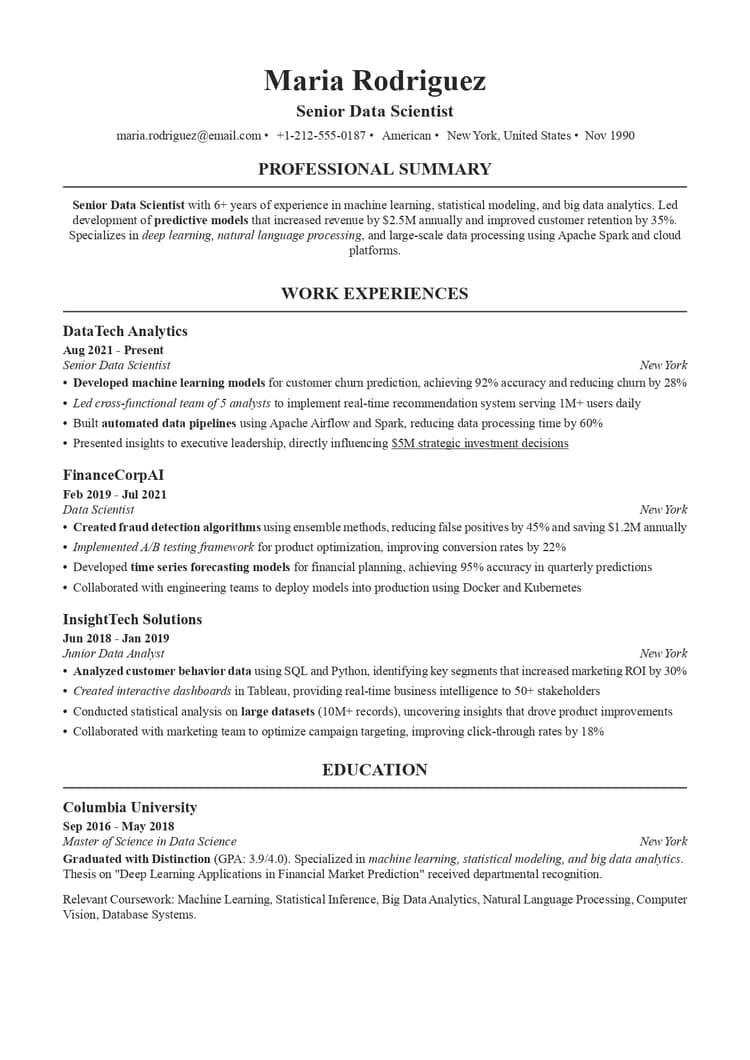
This 3-4 sentence section should include your target role, years of experience, and 3-5 key qualifications using exact keyword matches from the job description. For example:
Marketing Manager with 7+ years driving digital marketing strategies, SEO optimization, and content marketing campaigns. Proven expertise in Google Analytics, marketing automation, and conversion rate optimization, delivering 40% year-over-year growth in qualified leads.
Notice how that summary naturally incorporates multiple high-value keywords while remaining readable and specific. That's the balance you're aiming for.
#2. Skills Section
Create a dedicated skills section with 8-12 relevant keywords from your target job description. This is the easiest place for ATS software to scan and extract information, so formatting matters.
Use a simple bulleted list—nothing fancy that might confuse the parsing software. Group related skills if it makes sense, for instance:
- Technical Skills
- Software Proficiencies
- Languages
However, remember to match the exact terminology from job postings. If they say "Microsoft Excel," don't abbreviate it to "Excel" in your skills section.
#3. Work Experience Section
Your work experience is where keywords come alive with context. Integrate them naturally into bullet points that describe your accomplishments, following this formula: action verb + keyword + quantifiable result. For example:
- Implemented Python automation scripts that reduced data processing time by 40%, improving team productivity across 3 departments
Aim for 3-5 bullet points per position, with at least one keyword per bullet point. However, don't force it—if a particular accomplishment doesn't naturally incorporate keywords, it might not be the right one to highlight.
#4. Education and Certifications
Include exact degree names, your field of study, relevant coursework (for recent graduates), certifications, and ongoing professional development.
Use keywords exactly as they appear in requirements: "Bachelor of Science in Computer Science," not just "BS Comp Sci."
Best Practices for Using Resume Keywords
The table below outlines the best practices for using resume keywords:
Customize keywords for every job
Use exact phrases from job descriptions
Write naturally with keywords included
Add variations and abbreviations
Use standard industry titles and skills
Place keywords in key sections
Don'ts
Send the same generic resume everywhere
Rely only on loose or vague wording
Stuff keywords into awkward sentences
Use only one version of key terms
Rely on creative or unclear job titles
Hide important terms deep in your resume
4 Common Resume Keyword Mistakes to Avoid
Even when you understand the principles, it's easy to make resume mistakes that undermine your keyword strategy. Here are the most common pitfalls and how to avoid them:
- Keyword stuffing. Cramming keywords unnaturally into every sentence makes your resume difficult to read and can actually trigger ATS filters designed to catch this behavior. Modern ATS software measures keyword density and flags resumes that exceed reasonable thresholds.
- Using irrelevant keywords. Only include skills and qualifications you actually possess. Lying about keywords might get you past the ATS, but it'll get you rejected—or worse, fired—when you can't back up those claims in interviews or on the job.
- Forgetting to update for different roles. Marketing roles need different keywords than sales roles, even though they're related. Each job family within your field has its own specialized terminology and priorities. Always align your keywords with the specific position you're targeting.
- Hiding keywords in white text. This outdated "hack"—typing keywords in white font so they're invisible to humans but readable by ATS—is easily detected by modern systems and will get your resume automatically rejected. There's no shortcut here. The legitimate approach is integrating relevant keywords naturally throughout your resume's visible content.

Resume Keywords List by Industry
Here's a breakdown of high-value resume keywords by industry to give you a starting point for your research.
Technology Resume Keywords
- Programming languages (Python, Java, JavaScript, C++, Ruby)
- Frameworks and libraries (React, Angular, Node.js, Django)
- Methodologies (Agile, Scrum, DevOps, CI/CD)
- Cloud platforms (AWS, Azure, Google Cloud)
- Tools (Git, Docker, Kubernetes, Jenkins)
- Databases (SQL, MongoDB, PostgreSQL)
- Concepts (machine learning, artificial intelligence, API development, microservices architecture)
Healthcare Resume Keywords
- Patient care
- Clinical documentation
- HIPAA compliance
- EMR/EHR systems (Epic, Cerner, Meditech)
- Medical terminology
- Vital signs monitoring
- Medication administration
- Care planning
- Bedside manner
- Infection control
- Patient assessment
- Medical procedures
- Clinical protocols
- Interdisciplinary collaboration
- Certifications (BLS Certified, ACLS, RN License, CNA Certification)
Marketing Resume Keywords
- SEO/SEM
- Content marketing
- Social media marketing (Facebook, Instagram, LinkedIn, TikTok)
- Google Analytics
- Conversion Rate Optimization (CRO)
- Email marketing
- Marketing automation (HubSpot, Marketo, Mailchimp)
- Brand management
- Digital advertising
- PPC campaigns
- A/B testing
- Customer segmentation
- Marketing strategy
Finance Resume Keywords
- Financial analysis
- Budgeting
- Forecasting
- Variance analysis
- GAAP (Generally Accepted Accounting Principles)
- Financial modeling
- Excel advanced functions (VLOOKUP, pivot tables, macros)
- QuickBooks
- Accounts payable/receivable
- Reconciliation
- Audit preparation
- Financial reporting
- Cash flow management
- Cost analysis
- SOX compliance
- Internal controls
- Risk assessment
Customer Service Resume Keywords
- Interpersonal skills
- Customer satisfaction
- Conflict resolution
- CRM software (Salesforce, Zendesk, Freshdesk)
- Call center operations
- Ticketing systems
- Response time metrics
- Customer retention
- Issue resolution
- Communication skills
- Active listening
- Escalation management
- Multichannel support
- Problem-solving skills
- Product knowledge
Optimize Your Job Application with ResumeBuilder.so
Manual keyword research and optimization can take hours for each application. ResumeBuilder.so streamlines the entire keyword optimization process.
Our intelligent AI-powered resume builder matches your experience to what hiring managers and ATS systems are actually looking for. Also, it allows you to choose from professionally crafted resume templates designed to stand out in any industry.
To make your application more compelling, build a cover letter that personalizes your pitch in minutes. If you need inspiration, browse our library of real-world cover letter examples tailored to dozens of roles and industries.
ResumeBuilder.so streamlines every step of the job application process, so you spend less time optimizing and more time landing interviews.
Final Thoughts
Strategic keyword usage is about clearly communicating your qualifications in language that both technology and hiring managers understand. When you analyze job descriptions carefully, identify the keywords that matter, and integrate them naturally throughout your resume, you're simply translating your experience into the terminology your target employer uses.
Keywords must be authentic and backed by real experience. Don't claim expertise in skills you don't possess or list certifications you haven't earned. The goal is to make your genuine qualifications visible and discoverable, not fabricating new ones.
When your keywords accurately represent your capabilities, you'll not only pass ATS screening but also perform well in interviews because you can speak knowledgeably about everything listed on your resume.
Resume Keywords FAQs

Jordan Lee is your guide to navigating the rapidly changing job market in the age of AI and automation. He dives into how AI is reshaping hiring, the skills of the future, and what job seekers need to do now to stay relevant. If you’re curious about how technology is transforming careers and want to future-proof your job, Jordan’s insights are a must-follow.