13+ Essential Leadership Skills For Every Professional

Leadership skills matter at every career level—from your first job to the C-suite—and they're often what separates those who get promoted from those who don't. Whether you're leading a small project team or managing an entire department, your ability to guide, motivate, and influence others directly impacts your career growth and earning potential.
Employers consistently rank leadership abilities among their most desired qualities. Companies aren't just looking for people who can do the work—they want professionals who inspire others, solve problems, and drive change.
In this guide, we explore the 15 most valuable leadership skills you need, how to develop them, and proven ways to showcase these abilities on your resume.
- Leadership skills are valuable at every career level, not just management positions.
- Top leadership skills include communication, decision-making, and emotional intelligence.
- These skills can be learned through practice and experience.
- Showcasing leadership skills on your resume increases interview opportunities.
- Employers consistently rank leadership abilities among most desired qualities.
- Combining technical expertise with leadership skills creates competitive advantages.
What Are Leadership Skills?
Leadership skills are abilities that enable you to guide, motivate, and influence others toward common goals. These are primarily soft skills involving interpersonal communication, strategic thinking, and emotional intelligence. What makes them particularly valuable is their transferability across industries. For instance, if you master communication in marketing, you'll excel in finance or technology as well.
Research from McKinsey & Company supports this claim. Nearly 90% of what makes leaders effective comes down to four concrete behaviors that can be learned and practiced:
- Being supportive. This involves active listening, providing encouragement, and showing empathy when people face challenges. Supportive leaders make their teams feel valued beyond just their output, which builds trust and loyalty.
- Operating with a strong results orientation. These leaders set ambitious goals, hold themselves and others accountable, and persist through obstacles. They balance the supportive dimension by ensuring the team actually delivers on its commitments rather than just feeling good.
- Seeking different perspectives. Effective leaders actively solicit diverse viewpoints, especially from those who might disagree with them. They create space for debate and recognize that their initial instinct isn't always right. This behavior prevents groupthink and leads to better decisions.
- Solving problems effectively. These leaders break down complex challenges, identify root causes rather than symptoms, and develop workable solutions. They involve the right people in problem-solving and make decisions in a timely manner rather than getting stuck in analysis paralysis.
What's striking about these four behaviors is their universality—they mattered across all 81 organizations regardless of industry or geography. Master these four, and you've addressed the vast majority of what distinguishes effective leaders from ineffective ones.
Why Are Leadership Skills Important?
Leadership skills are important for several reasons, including:
- Career advancement. These skills are prerequisites for promotions into management and executive roles. Companies promote people who've already proven they can lead, not those hoping to figure it out later.
- Workplace impact. Strong leadership improves team performance, workplace culture, and organizational success. Leaders mentor struggling colleagues, suggest process improvements, and keep teams motivated during challenging projects.
- Professional marketability. Professionals who effectively showcase leadership competencies on their resume receive more interview requests than those with purely technical skills. Leadership qualities signal that you're not just a worker—you're someone who adds strategic value.
15 Essential Leadership Skills for Professional Success
Mastering these leadership competencies enhances your professional effectiveness at any career stage. Including these skills for resume requires translating them into concrete, demonstrable accomplishments rather than simply listing them as buzzwords.
That said, let’s examine each of these essential leadership skills and how to showcase them on your resume.
#1. Communication Skills
Effective communication is leadership's foundation. You need verbal clarity for presentations, written precision for emails, and non-verbal awareness to read situations. Active listening matters more than talking—truly hearing colleagues, asking questions, and adapting your style builds trust and influence.
Here’s how that might look on your resume:
- Delivered quarterly presentations to C-suite executives, resulting in approval of $1.5M budget increase; authored company-wide policy documentation that reduced onboarding time by 30%
#2. Emotional Intelligence
Emotional intelligence means understanding your own emotions while recognizing others' feelings. It covers self-awareness, self-regulation, empathy, and social skills. Research suggests EQ often predicts leadership success better than IQ because technical brilliance doesn't help if you can't manage conflict or motivate discouraged teams.
That said, let’s see how you can demonstrate emotional intelligence on your resume:
- Identified early burnout indicators across team and implemented flexible scheduling, reducing turnover from 28% to 12% within one year
#3. Decision-Making and Problem-Solving
Leaders analyze situations, weigh options, and make sound decisions under pressure with incomplete information. This involves critical thinking, risk assessment, and courage to make difficult choices. The best decision-making combines data analysis with intuitive judgment.
Here’s a good way to showcase this on your resume:
- Analyzed underperforming product line and recommended discontinuation, reallocating resources to generate $800K in additional revenue within 6 months
#4. Strategic Thinking and Vision
Strategic thinkers see the big picture, anticipate trends, and create long-term plans aligning daily actions with broader objectives. This means connecting dots others miss and preparing for multiple scenarios rather than just reacting to immediate problems.
Let’s see how to demonstrate this on a resume:
- Forecasted emerging market trends and developed a 3-year expansion strategy that positioned the company ahead of competitors, capturing 23% market share
#5. Delegation and Empowerment
Delegation maximizes team potential by assigning tasks effectively, trusting people with real responsibility, and empowering ownership. Strong delegators consider individual strengths, provide clear expectations, and then step back without micromanaging.
Here’s a good way to highlight this on your resume:
- Delegated client presentations to 3 junior team members with structured coaching, resulting in all three receiving promotions within 18 months
#6. Motivation and Inspiration
Leaders energize teams toward common goals through intrinsic motivation (connecting work to purpose) and extrinsic motivation (recognition and advancement). They create enthusiasm by linking daily tasks to larger missions and celebrating progress.
Let’s see how this might look on your resume:
- Increased team productivity by 34% by connecting daily tasks to the company mission and implementing a monthly recognition program
#7. Conflict Resolution
Strong leaders mediate disputes, find common ground, and maintain harmony without avoiding difficult conversations. This requires negotiation, diplomacy, and separating issues from personalities while addressing tensions early.
This is how that might look on your resume:
- Mediated cross-departmental dispute over resource allocation, facilitating compromise that improved inter-team collaboration scores by 45%
#8. Adaptability and Flexibility
Adaptable leaders adjust strategies, stay composed during uncertainty, and pivot when circumstances shift. They embrace change, model flexibility, and help others navigate transitions smoothly rather than rigidly following outdated plans.
Here’s how you can emphasize it on your resume:
- Led 50-person team through emergency remote transition in 72 hours, maintaining 98% productivity levels and zero client disruption
#9. Accountability and Integrity
Taking responsibility for outcomes—especially failures—and maintaining ethical standards builds trust. Leaders with strong accountability admit mistakes publicly, outline corrections, and hold themselves to standards they expect from others.
Let’s see a good example of that on a resume:
- Publicly acknowledged project delay, implemented a corrective action plan, and delivered final results 2 weeks ahead of the revised timeline
#10. Team Building and Collaboration
Creating cohesive teams means fostering cooperation, leveraging diverse strengths, and building psychological safety. Strong collaboration skills recognize what each person contributes and create inclusive cultures where everyone's input is valued.
That said, here’s how to demonstrate these on a resume:
- Built cross-functional team of 12 from 4 departments, improving solution quality scores from 73% to 94% through structured collaboration framework
#11. Mentoring and Coaching
Developing others through guidance and feedback helps people reach potential while building organizational capability. Effective mentors share knowledge, provide honest feedback, and invest time helping others develop new skills.
That said, here’s how you might demonstrate your mentorship and coaching skills:
- Mentored 6 junior analysts through skills development program, with 5 earning promotions and 100% retention over 2-year period
#12. Time Management and Prioritization
Leaders organize work efficiently, set priorities based on strategic importance, and meet deadlines while managing competing demands. This means distinguishing urgent from important and protecting time for high-value activities.
Let’s see how you might show your time management and prioritization skills:
- Managed 15 concurrent projects while reducing team overtime by 40% through implementation of priority matrix and workflow automation
#13. Innovation and Creativity
Leaders generate new ideas, encourage creative thinking, and implement innovative solutions. They create environments where experimentation is encouraged, and failures become learning opportunities rather than career setbacks.
Here’s a good way to highlight these skills on your resume:
- Established quarterly innovation sessions generating 28 process improvement ideas, with 8 implemented saving $340K annually
#14. Cultural Intelligence and Inclusion
Working effectively across cultures and creating inclusive environments matters increasingly in global workplaces. Cultural intelligence means understanding how backgrounds shape communication styles and adapting leadership approaches accordingly.
Let’s see how you can showcase this on your resume:
- Managed diverse 20-person global team across 7 countries, achieving 92% employee engagement score by adapting communication protocols to cultural preferences
#15. Resilience and Stress Management
Maintaining composure under pressure, bouncing back from setbacks, and modeling healthy stress management helps teams navigate challenges. Resilient leaders view failures as temporary and maintain focus on solutions.
For example:
- Maintained team focus and morale during company restructuring, achieving all quarterly targets despite 30% staff reduction and departmental uncertainty
How to Develop Leadership Skills: 5 Proven Strategies
Developing leadership competencies requires intentional effort and practice. According to a well-known 70/20/10 rule, 70% of leadership capability comes from challenging assignments, 20% from relationships and feedback, and 10% from formal training.
Therefore, these skills are built through effort, and here's how to strengthen them systematically:
- Seek leadership opportunities. Volunteer for team projects, coordinate initiatives, mentor colleagues, or organize professional activities. Every time you guide others or take ownership of outcomes, you're building leadership capabilities without needing a management job title.
- Pursue formal training. Leadership courses, workshops, and certifications provide structured frameworks for development. Platforms like Coursera and LinkedIn offer accessible options from quick modules to comprehensive programs that work best when combined with practical application.
- Learn from leaders you admire. Study successful leaders in your organization. Read leadership books, listen to podcasts, and observe how effective leaders handle challenges. Adapt what you learn to your authentic style rather than just imitating others.
- Practice self-reflection. Regularly assess your strengths and weaknesses through honest self-evaluation. After important meetings or decisions, ask what went well and what could improve. Developing a willingness to learn signals leadership potential more than claiming perfection.
- Gain diverse experiences. Take on cross-functional projects, work with different teams, and step outside your comfort zone. Each new experience builds pattern recognition for handling future situations and creates versatile leadership skills.
How to Showcase Leadership Skills on Your Resume
Showcasing your leadership skills effectively on a resume requires strategic presentation that catches recruiter attention and passes ATS screening. Let’s examine the best place on your resume where you can emphasize these skills.
Resume Summary
Mention 2-3 key leadership strengths with concrete examples in your professional summary. For example:
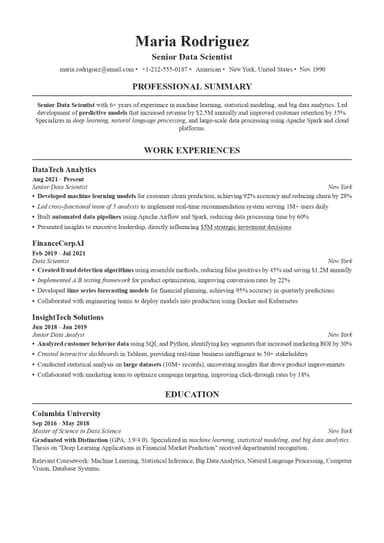
Results-driven marketing professional with 7+ years leading cross-functional teams of up to 15 members. Proven track record of mentoring junior staff and driving a 40% increase in campaign performance through collaborative leadership.
Work Experience Section
Use action verbs and quantifiable achievements to demonstrate leadership in your work experience. Show scope through numbers—team sizes, budgets, or measurable outcomes.
Here are a few strong examples of result-focused bullet points:
- Led team of 8 engineers developing new platform feature, delivering project 2 weeks ahead of schedule
- Mentored 5 junior analysts, with 3 receiving promotions within 18 months
- Spearheaded process improvement reducing cycle time by 30%
Skills Section
List specific leadership skills relevant to your target role. Balance hard skills and soft skills, only including abilities you can support with examples. For instance:
- Team Leadership & Development
- Strategic Planning & Execution
- Cross-Functional Collaboration
Common Leadership Challenges and How to Overcome Them
A staggering 60% of managers fail within the first two years in their new role. The table below outlines the most common leadership challenges and how to overcome them:
| Challenge | What It Looks Like | How to Handle It Effectively |
|---|---|---|
Imposter Syndrome | Doubting your skills and leadership ability | Track achievements, seek mentors, and remember growth always feels uncertain |
Managing Former Peers | Feeling awkward supervising past colleagues | Acknowledge the shift, set clear expectations, and act consistently |
Balancing Authority & Approachability | Struggling to lead without becoming distant or too casual | Stay supportive, set boundaries, and enforce standards fairly |
Time Management Pressures | Feeling overwhelmed by added responsibilities | Prioritize key tasks, delegate wisely, and protect focus time |
Showcase Your Leadership Expertise With ResumeBuilder.so
ResumeBuilder.so streamlines the entire resume-making process. Whether you're transitioning into management or advancing to executive roles, our AI-powered resume builder helps you emphasize leadership skills in your summary, quantifying team achievements in your experience section, and balancing technical and interpersonal competencies.
Choose from professionally designed, ATS-friendly resume templates that recruiters trust, access real-world resume examples for inspiration, and build a compelling leadership narrative in minutes. Stop struggling with formatting—let ResumeBuilder.so handle the structure while you focus on your story.
Final Thoughts
Leadership skills represent your most valuable career investment—they're transferable across industries and directly correlated with advancement and compensation. The competitive job market rewards professionals who guide teams, drive results, and inspire others.
Start developing these skills immediately, regardless of current position. Every project you coordinate or colleague you mentor builds capability. Small actions compound—consistent leadership in small ways today makes you the obvious choice for bigger responsibilities tomorrow.
Leadership Skills FAQs

Emily Foster knows how nerve-wracking it can be to land your first job—she’s been there. As a mentor for young professionals, she shares exactly what hiring managers want from entry-level candidates. From internship hacks to interview confidence tips, Emily helps students and recent grads navigate the job search with ease.